




Version 2023.1 published January 10th, 2023
2023 Technical Regulations
Introduction
The trophy is for cars which comply with the original regulations of Formula 3 between 1964 and 1970. With the aim of the Historic F3 1000cc European Trophy being to revive the great international Formula 3 races of the 60’s, any technical feature not used in period (e.g. carbon, ceramic coated pistons, cockpit adjustable anti-rollbars and data logging) must not be used in the trophy either.
Eligible Cars
One litre single-seater Formula 3 cars built between January 1st, 1964 and December 31st, 1970 to the FIA defining regulations in place at that period; separated in two classes.
Class A for cars built between 01/01/1964 and 31/12/1966 with side draught carburettor and wheels to a maximum width of 6.5”.
Class B for cars built between 01/01/1967 and 31/12/1970 or any car running with a downdraught carburettor and/or wheels wider than 6.5”.
Scoring and sporting regulations will be identical in class A and B, separate trophies will be awarded to the winner of each class.
All cars must comply with the rules of 1970 Appendix "J" Article 295 and current Appendix "K" and must remain in their original period specifications.
Chassis and Bodywork
As original. The points to which the suspension elements are attached to the frame must not differ in dimension or positions from the period specification. All sprung parts of the car must have a minimum ground clearance of 40 mm with the driver on board.
The use of any material which was not in general use during the period (e.g. titanium, kevlar, carbon fibre, etc.) is prohibited.
In order to reduce the engine coolant temperature, it is permitted to deviate from the HSCC vehicle identity form and/or the FIA Historic Technical Passport in relation to bodywork to add additional tabs to the air exits from the radiator and also to increase the area of the intake to the radiator to improve the cooling air flow. Any additional tabs added should be limited to 50 mm protrusion from the adjacent bodywork. They may be at any angle to the general plan profile, however in side elevation they must be nominally vertical (±15 degree).
Aerodynamic Devices
Any front or rear aerofoils or aerodynamic devices are not permitted as well as any modifications of bodywork which were not originally used in period.
Engines
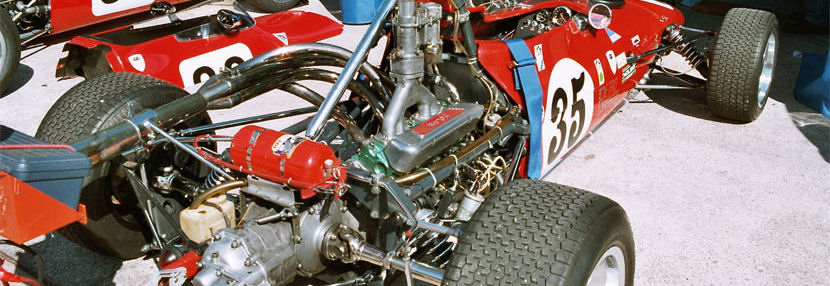
They have to comply with the requirement of the original Appendix "J" 1964-1970 Articles 295 & 296. Engines must have a maximum of 4 cylinders with a maximum capacity of 1000cc, excluding all engines with overhead camshafts.
Only one carburettor, whatever its number of chokes, may be used. All the carburetted mixture must pass through a throttling restrictor of 36 mm in diameter and 3 mm minimum thickness which must be placed between the carburettor and the inlet manifold. This shall include the period Novamotor slide throttle type where the lead in taper extends into the carburettor.
In general the use of any material which was not in general use during the period (e.g. titanium, kevlar, carbon fibre, etc.) is prohibited. However, the use of titanium valve retainers as used in period is permitted.
Ignition must be by a distributor with a mechanical centrifugal advance. Multiple spark systems and systems were the timing of the spark is altered electronically are not permitted. The system must contain only a single ignition coil with distribution by the distributor.
From 1st of January 2018, the minimum stroke must not be less than 1.902" (48.31 mm). From 1st of January 2019, the minimum diameter of the crank pin journal must not be less than 1.8926" (48.072 mm) and the minimum diameter of the main bearing journal must not be less than 2.085" (52.959 mm).
Gearbox
As originally defined, with 4 forward gears and a reverse. The use of Hewland MK8 box is permitted. The choice of gear ratios is free. The use of any limited slip or torque biasing differential is not permitted. Safety centralizing shafts must be fitted between the drive shafts and the gearbox output shafts to maintain the drive shaft location in the event of a failure of the rotoflex couplings.
Suspension
As original period specification. Springs and shock absorbers are free but the mountings to the frame must not differ from the dimensions or positions for the period specification. Dampers which are adjustable in compression and rebound are permitted; the use of damper with external or remote reservoirs is prohibited.
Wheels
Their dimensions will not be able to be more than (diameter x width):
Class A front and rear 13" x 6.5".
Class B front 13" x 9", rear 13" x 11".
Tyres
Class A for cars built prior to December 31st 1965 and fitted with side draught engines and wheel rims 13" diameter and a maximum width of 6.5".
For all conditions AVON ACB9 A37 compound code numbers front 7660 and rear 7661 or Dunlop ‘L’ and ‘M’ section.
Class B for cars built after December 31st 1965 and/or all cars fitted with downdraft carburettor.
For dry conditions AVON slick cut to CR65 dry pattern, A37 compound, code numbers front 7342 and rear 7343, pattern references H002 and H004 (for details open PDF drawing by clicking the reference number link) or Dunlop ‘L’ and ‘M’ section cut to CR65 thread pattern and 204 compound or ‘Post Historic’ 204 compound.
For wet conditions AVON slick cut to wet pattern, A27 compound, code numbers front 7277 and rear 7278, pattern references W002 and W005 (for details open PDF drawing by clicking the reference number link), AVON slick cut to wet pattern, A37 compound, code numbers front 7714 and rear 7715 (no longer manufactured but still allowed), or Dunlop ‘L’ and ‘M’ section cut to CR65 thread pattern and 204 compound or ‘Post Historic’ 204 compound.
Please note that for AVON tyres, the recommended installation in the front is with the specification number to the left and on the rear with the number to the right.
Brakes
As originally period specification with dual hydraulic circuits.
Weight
The minimum weight is 400 kg. The minimum weight is that of the car in running order i.e. with all lubrication and cooling liquids but without fuel.
Please note that, according to Appendix "K", ballast of a removable type is prohibited. If ballast is required it may be added as solid unitary blocks and must be securely fixed by means of a tool and offer the opportunity of being sealed should the officials entrusted with the scrutineering of the car deem necessary.
Fuel
Only usual commercial fuel is authorized. The characteristics must not exceed 102.0 RON and 90.0 MON.
Safety
The cars must comply with the safety requirements of the current Appendix "K" Article 5. All cars must be equipped with at least a hand-operated fire extinguisher complying with current Appendix "J", Article 253-7.3. However, it is strongly recommended that a plumbed-in extinguisher system homologated by the FIA in accordance with the current Appendix "J", Article 253-7.2 is fitted.